Water is essential for a healthy landscape, but when it collects around your home, it can quickly become a serious problem. A lawn that remains muddy after rainfall, water pooling near a foundation, or a basement that repeatedly develops damp patches can indicate that your property needs a better drainage solution. These problems are particularly frustrating because they often become more noticeable during periods of heavy or prolonged rain.
One practical solution is a French drain. This underground drainage system collects excess groundwater and redirects it toward a suitable discharge point. When correctly designed and installed, it can help protect foundations, reduce standing water, and improve the condition of outdoor spaces.
However, successful french drain installation involves more than digging a trench and placing a pipe inside it. Soil conditions, excavation depth, drainage direction, gravel quality, pipe selection, and installation costs all influence the final result.
Understanding these details helps homeowners make informed decisions before starting a drainage project. Whether you are dealing with a flooded backyard or protecting your home’s foundation, learning how the system works can save time, money, and unnecessary repairs.
Understanding How a French Drain Works
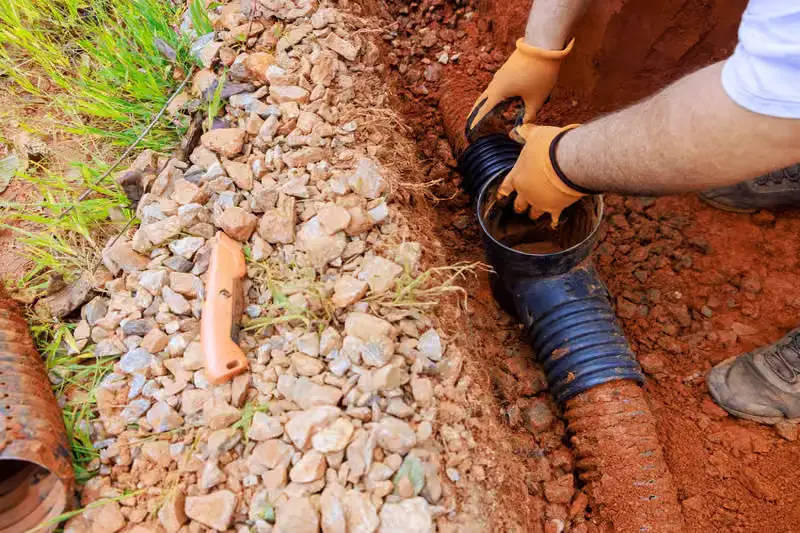
A French drain is a subsurface drainage system designed to collect and move unwanted groundwater away from areas where it can cause damage. Its basic structure consists of a gravel-filled trench containing a perforated drainage pipe.
Water naturally moves through the surrounding soil and enters the gravel-filled trench. The gravel creates an open pathway that allows water to reach the perforated pipe. From there, gravity carries the collected water toward a designated outlet, provided the system has sufficient slope.
The concept is relatively simple, but the engineering behind effective french drain installation requires careful planning.
For example, imagine a backyard where rainwater repeatedly collects near a patio. The soil stays saturated, grass becomes unhealthy, and the area remains unusable for several days. A properly positioned French drain can intercept some of this excess groundwater and redirect it toward an appropriate discharge location.
The Main Components of a French Drain
The perforated pipe is responsible for transporting collected water. Residential systems commonly use drainage pipes approximately three to four inches in diameter, although the correct size depends on the expected water volume and project design.
Washed gravel or drainage stone surrounds the pipe. Its purpose is to create spaces through which water can move freely. Clean aggregate is important because excessive fine material can reduce drainage efficiency.
Geotextile filter fabric helps separate surrounding soil from the drainage aggregate. Without suitable filtration, soil particles can gradually enter the gravel and reduce its ability to transmit water.
The trench itself provides the necessary pathway and slope. Every component must work together for reliable drainage.
When Does Your Property Need a French Drain?
Not every drainage problem requires an underground drainage system. Sometimes, adjusting the landscape or extending roof downspouts is enough to solve the issue. However, persistent water accumulation may indicate that surface-level solutions are not addressing the underlying problem.
Recognizing the warning signs early can prevent more expensive property repairs.
Persistent Standing Water in the Yard
If puddles remain in your garden long after rainfall has stopped, your soil may have poor drainage or your property may have an unsuitable natural slope. Clay-heavy soil is particularly challenging because it absorbs and releases water more slowly than many sandy or loamy soils.
In these situations, french drain installation may help intercept groundwater before it accumulates in low areas.
Water Near the Foundation
Water collecting close to exterior walls deserves attention. Repeated exposure to moisture can contribute to basement leaks, damp crawl spaces, and deterioration of certain building materials.
A foundation drainage system can help redirect groundwater away from vulnerable areas. However, drainage should be combined with appropriate grading, functioning gutters, and foundation waterproofing when necessary.
Erosion Around Walkways and Landscaping
Uncontrolled runoff can gradually remove soil from garden beds, damage planting areas, and weaken the ground around walkways. A carefully designed drainage route can reduce the amount of water flowing across vulnerable surfaces.
Damp Basements and Crawl Spaces
Persistent basement moisture may result from groundwater pressure, leaking foundations, plumbing problems, or inadequate surface drainage. An interior or exterior French drain may help when groundwater is responsible.
A professional inspection is important because a drainage pipe cannot correct every type of water intrusion.
Different Types of French Drain Systems
Choosing the correct system is one of the most important decisions in a drainage project. The design should reflect where water accumulates, how it moves through the property, and where it can safely discharge.
Exterior French Drains
Exterior French drains are installed outside the home, often around a foundation or within a landscaped area. They collect groundwater before it reaches vulnerable structures.
These systems usually involve excavating a trench, installing drainage aggregate and perforated pipe, and restoring the surrounding landscape.
Exterior drainage is particularly useful when water enters the property from higher ground or collects around the foundation after heavy rainfall.
Interior French Drains
Interior French drains are commonly used in basements where groundwater enters through foundation walls or floor joints.
Installation generally involves cutting a section of the basement floor, excavating along the perimeter, and placing a drainage channel or perforated pipe beneath the floor surface.
Collected water usually flows toward a sump basin, where a pump moves it outside.
Interior systems can be effective, but they require more specialized construction work because existing concrete flooring must be disturbed and restored.
Curtain French Drains
A curtain drain is designed to intercept groundwater moving through soil before it reaches a particular area. It is commonly installed across a slope or above a waterlogged section of a property.
For example, a homeowner whose garden sits below an elevated neighboring area may experience repeated water movement downhill. A curtain drain can intercept that flow and redirect it toward a suitable outlet.
Deep French Drains
Deep French drains are designed to address groundwater conditions below the surface. They may be appropriate when ordinary shallow drainage trenches cannot reach the water-bearing soil layer.
Their installation requires more detailed site assessment because excavation depth, soil stability, groundwater levels, and nearby foundations influence the design.
Planning French Drain Installation Before Excavation
Good drainage begins with understanding the property rather than immediately starting construction.
A poorly positioned drain may collect water without providing an effective route for removing it. In some cases, it can even transfer the problem to another part of the property.
Assessing the Landscape and Water Flow
Start by observing the property during and after rainfall. Identify where puddles form, which areas remain wet, and the direction water naturally travels.
Pay particular attention to downspouts, driveways, retaining walls, garden beds, and low sections of the yard.
A drainage professional may use elevation measurements, soil investigations, and site observations to determine the best trench location.
The objective is to intercept excess water without creating additional drainage problems.
Understanding Soil Conditions
Soil type significantly affects drainage performance.
Sandy soil generally allows water to move relatively easily, while clay-rich soil has smaller pores and can retain moisture for longer periods. Silty soils may also create filtration challenges because fine particles can migrate into drainage materials.
A soil assessment helps determine the appropriate gravel, filter fabric, trench depth, and drainage arrangement.
This is particularly important when planning french drain installation in properties with compacted or poorly draining ground.
Selecting a Suitable Drainage Outlet
Every French drain needs somewhere to send collected water.
Depending on local regulations and site conditions, possible outlets include an approved stormwater connection, a suitable drainage ditch, or a properly designed infiltration area.
A dry well may also be appropriate where soil conditions and groundwater levels allow it.
Water should never be discharged onto a neighboring property, public walkway, or location where it could undermine structures or create flooding.
Before construction, check local drainage requirements and obtain any necessary approvals.
Excavation: Preparing the Trench Correctly
Excavation is one of the most important stages because the trench determines the route, depth, and slope of the drainage system.
Even high-quality materials cannot compensate for an incorrectly excavated trench.
Determining the Correct Trench Depth and Width
The required dimensions depend on the type of drainage problem and the system’s design.
A shallow yard drainage trench may require considerably less excavation than a deep foundation drainage system.
Residential yard drains are often installed approximately 8 to 24 inches below ground, although this is not a universal specification. Foundation drainage may need to follow different engineering requirements.
The trench must be wide enough to accommodate the pipe, surrounding aggregate, and necessary filter material.
Before excavation begins, underground electricity cables, water pipes, gas lines, and communication services must be identified. In the United States, homeowners can contact 811 before digging to request utility marking. Other countries have their own utility-location procedures.
Establishing the Correct Slope
Gravity is what makes most French drains work without mechanical assistance.
The trench should have a consistent downward gradient toward the discharge point. A commonly used residential guideline is approximately a 1% slope, equivalent to one inch of fall over eight feet.
Some projects use a different gradient depending on the pipe specifications, terrain, and hydraulic design.
For instance, a 40-foot drainage line with a 1% slope would require approximately 4.8 inches of total elevation difference.
A contractor should verify the actual elevations before laying the pipe. An inconsistent trench can create low spots where sediment collects and water moves too slowly.
Preparing the Trench Base
Once excavation is complete, the trench bottom should be smooth and free from loose debris, large roots, and unstable material.
The installer then prepares the filter fabric and drainage aggregate according to the system design.
The goal is to create a stable, continuous pathway that allows water to enter the pipe without excessive soil movement.
Materials Required for a Reliable French Drain
Material selection influences both installation quality and long-term maintenance.
Perforated Drainage Pipe
Perforated PVC and corrugated polyethylene pipes are common options for residential drainage projects.
Rigid PVC offers structural strength and maintains its shape, while flexible corrugated pipe can be easier to install around curved routes.
The appropriate option depends on soil conditions, loading requirements, pipe diameter, and manufacturer specifications.
Washed Gravel and Drainage Stone
Clean, washed aggregate provides open spaces through which water can travel.
Many residential systems use gravel or crushed stone around three-quarters of an inch in size, although the correct grading depends on the soil and drainage design.
Using ordinary soil-filled stones or contaminated construction material can introduce fine particles and reduce the system’s effectiveness.
Geotextile Filter Fabric
Geotextile fabric separates surrounding soil from the drainage aggregate while allowing water to pass through.
It should be selected according to soil particle size and water-flow requirements.
An important technical consideration is that wrapping the pipe directly in fabric is not automatically the best solution. In fine-grained soils, a pipe sock can become clogged because filtration occurs over a relatively small surface area. Properly designed fabric placement around the aggregate may offer better filtration in certain conditions.
The U.S. Bureau of Reclamation’s drainage design guidance discusses the potential clogging problems associated with geotextile-wrapped pipes.
The French Drain Installation Process
Once the design and materials are ready, construction can begin. A professional installation generally follows a planned sequence to maintain consistent drainage and prevent avoidable problems.
Step One: Marking the Drainage Route
The installer marks the trench location based on the site’s elevation, water accumulation points, and discharge location.
The route should avoid unnecessary bends and obstacles. It should also provide enough room for excavation equipment and future maintenance.
Step Two: Excavating the Trench
The trench is excavated to the required depth and width. Excavated soil is placed away from the work area so it does not fall back into the trench.
For larger projects, mechanical excavation equipment can reduce labor time. Smaller garden installations may be completed using hand tools.
Step Three: Installing Filter Fabric
The geotextile is positioned according to the drainage design, leaving sufficient material to overlap the aggregate after installation.
Its purpose is to reduce soil contamination while maintaining water movement.
Step Four: Adding the Gravel Base
A layer of clean drainage stone is placed along the trench bottom.
The pipe is then positioned at the required elevation and gradient.
Step Five: Connecting the Pipe
The perforated pipe is installed with compatible fittings and connected to the approved discharge route.
The orientation of perforations depends on the pipe design and manufacturer’s instructions. Some pipes have holes along their entire circumference, while others use specific opening arrangements.
Step Six: Covering the Pipe With Gravel
Additional washed gravel is placed around and above the pipe to create a continuous drainage zone.
The amount of aggregate depends on trench dimensions and the design requirements.
Step Seven: Closing and Restoring the Trench
The filter fabric is folded over the aggregate where specified. The remaining trench is then covered with suitable soil or landscaping material.
Grass, garden beds, and other disturbed surfaces can be restored after the system has been checked.
Proper french drain installation should finish with an inspection of the pipe route, outlet, and surrounding ground.
French Drain Installation Cost: What Should Homeowners Expect?
Budget is often one of the biggest considerations when planning a drainage project. The total cost depends on the drain’s length, excavation depth, material selection, labor requirements, and difficulty of accessing the installation area.
There is no single price that applies to every property. A straightforward garden drain may be relatively affordable, while a deep foundation system involving concrete removal and a sump pump can require a substantial investment.
Average French Drain Installation Cost
Recent 2026 cost estimates published by HomeAdvisor and Angi provide useful US market benchmarks. Professional projects generally range from approximately $400 to $27,000, while many reported residential installations fall between $500 and $18,000. One published national average is approximately $9,250.
Home Advisor+1
These figures are US estimates rather than universal prices. Actual costs in other countries will depend on local labor rates, material availability, excavation equipment, and construction standards.
The following comparisons illustrate how different drainage systems affect project budgets.
Exterior French Drain Costs
Exterior French drains commonly cost around $10 to $50 per linear foot in US estimates. The final amount depends on trench depth, soil conditions, and the distance between the collection area and discharge point.
A relatively simple curtain drain may cost approximately $10 to $25 per linear foot, while more complicated deep drainage projects can reach $30 to $70 per linear foot.
Interior French Drain Costs
Interior basement drainage is generally more expensive because it involves additional construction work.
Typical published estimates range from $40 to $100 per linear foot. Contractors may need to remove sections of concrete, excavate below the floor, install drainage channels, and restore the flooring.
If a sump pump is necessary, its installation can add approximately $500 to $2,000 to the project, depending on equipment and labor.
Factors That Influence Installation Expenses
Several factors explain why two properties can receive very different quotes for similar drainage systems.
Soil composition: Rocky ground and compacted clay can make excavation slower and more expensive. Loose, easily excavated soil may reduce labor requirements.
Trench length and depth: Longer drainage routes require more pipe, gravel, filter fabric, and excavation. Deeper trenches may also require additional safety precautions and specialized equipment.
Property accessibility: Narrow side yards, existing patios, mature trees, and nearby structures can make equipment access difficult.
Landscape restoration: Removing and replacing grass, paving, decorative stones, and garden features can increase the final bill.
Permits and inspections: Local authorities may require drainage approvals, inspections, or specific discharge arrangements.
When comparing contractors, homeowners should request an itemized quotation rather than choosing a company based only on its advertised price.
DIY Versus Professional French Drain Installation
Some homeowners consider installing a French drain themselves to reduce labor costs. This can be reasonable for a small, straightforward yard drainage project when the ground is accessible and the discharge route is already established.
However, DIY work requires more than basic digging skills.
You must understand grading, calculate the trench slope, select compatible materials, and make sure water reaches an appropriate outlet. Mistakes can result in standing water, blocked pipes, or repeated excavation.
Professional french drain installation is generally preferable when the project involves foundation protection, basement flooding, deep excavation, difficult soil, or complicated connections.
Experienced drainage contractors can evaluate the property’s water movement and recommend a system that addresses the underlying problem instead of simply moving water from one location to another.
When DIY Installation Makes Sense
A small garden trench with a clear downward route and no complicated underground obstacles may be manageable for an experienced homeowner.
Nevertheless, utility locations, local building regulations, and safe excavation practices must be considered before starting.
When Professional Assistance Is Worth the Investment
If water is entering your basement, affecting retaining walls, or collecting near structural foundations, professional assessment becomes especially important.
A drainage specialist can also identify whether the problem requires a French drain, surface grading, waterproofing, a sump pump, or a combination of solutions.
Common French Drain Problems and How to Prevent Them
A French drain should provide consistent drainage rather than becoming another maintenance problem. Unfortunately, poor design and installation can reduce its performance.
Clogged Drainage Pipes
Soil particles, roots, leaves, and sediment can eventually restrict water movement.
Using suitable filter fabric, clean aggregate, and accessible inspection points helps reduce this risk.
Incorrect Pipe Slope
A trench with insufficient or inconsistent slope may allow water to collect instead of moving toward the outlet.
Professional elevation checks during french drain installation help prevent this issue.
Poorly Selected Gravel
Fine or contaminated aggregate can reduce the open spaces needed for water movement. Washed drainage stone is generally a better choice for maintaining permeability.
An Inadequate Discharge Point
Even a correctly installed pipe cannot perform effectively if its outlet is blocked, undersized, or positioned where water cannot escape.
The discharge location should be checked during installation and periodically afterward.
Ignoring the Original Water Source
A French drain is not always the first solution to a wet yard. Leaking downspouts, broken irrigation lines, poor surface grading, and plumbing leaks can produce similar symptoms.
Identifying the actual source of moisture helps prevent unnecessary construction expenses.
Maintaining Your French Drain for Long-Term Performance
Although French drains are mostly underground, they still need occasional attention.
Start by inspecting the visible outlet after heavy rainfall. Water should leave the system without obvious obstruction or backup.
Keep leaves, soil, and garden debris away from outlet openings. If the system includes an inspection chamber, check it periodically for sediment accumulation.
It is also useful to monitor the original problem area. If water begins collecting again, investigate whether the outlet is blocked, the surrounding soil has changed, or the drainage system has developed a damaged section.
Avoid planting large trees directly beside drainage routes because growing roots may eventually interfere with pipes or connections.
A properly designed and maintained system can provide many years of service. However, actual lifespan depends on material quality, soil conditions, installation workmanship, and maintenance requirements.
How French Drains Support Sustainable Rainwater Management
Effective rainwater management is about more than removing unwanted water. It also involves protecting soil, reducing erosion, and managing runoff responsibly.
A French drain can support these goals by intercepting excess groundwater and directing it toward a suitable drainage or infiltration system.
For example, a property with a frequently flooded garden might benefit from a French drain connected to a properly designed infiltration area. Where conditions allow, this approach can help water soak into the ground rather than immediately contributing to surface runoff.
However, infiltration is not appropriate everywhere. Clay-heavy soils, shallow groundwater, contaminated ground, and nearby foundations may make certain infiltration arrangements unsuitable.
A site assessment helps determine whether collected water should enter an approved stormwater system, a dry well, or another permitted discharge arrangement.
Combining french drain installation with appropriate landscaping, rain gardens, permeable paving, and properly directed downspouts can create a more complete rainwater management strategy.
Choosing the Right Contractor for Your Drainage Project
Selecting an experienced contractor can make a significant difference to the quality and reliability of the finished system.
Look for professionals who understand residential drainage, excavation, soil conditions, and foundation protection. Ask how they will identify the source of the water problem before recommending a particular design.
A good contractor should explain the proposed trench route, pipe material, gravel specifications, filter arrangement, slope, and discharge location.
Request a written estimate that separates excavation, materials, labor, equipment, permits, and landscape restoration.
It is also worth asking about workmanship warranties, maintenance requirements, and what happens if the original drainage problem continues after installation.
Do not automatically choose the cheapest quotation. A poorly designed system can cost more over time when repairs and repeated excavation become necessary.
Is French Drain Installation a Worthwhile Investment?
For properties experiencing recurring groundwater problems, a French drain can be a practical long-term investment.
It helps control water movement, reduces persistent soil saturation, and can protect vulnerable areas around buildings. It may also improve outdoor usability by reducing muddy patches and standing water.
However, its value depends on whether the system addresses the actual cause of the drainage problem.
Before committing to construction, evaluate the soil, property slope, water source, and available discharge options. Compare professional estimates and make sure the proposed design meets local requirements.
A carefully planned french drain installation is not simply an underground pipe project. It is a complete drainage solution that combines excavation, filtration, water collection, and controlled discharge.
When these elements work together, homeowners can enjoy healthier landscapes, better rainwater management, and greater confidence during periods of heavy rainfall.
Frequently Asked Questions
1. How long does French drain installation take?
Most residential projects take one to three days, depending on excavation, length, soil, and site accessibility.
2. How deep should a French drain be?
Many yard drains are 8–24 inches deep, depending on drainage requirements.
3. Does a French drain require maintenance?
Yes. Inspect outlets, remove debris, and check for blockages periodically to maintain effective water flow.